Hampton County Dog Registration Information
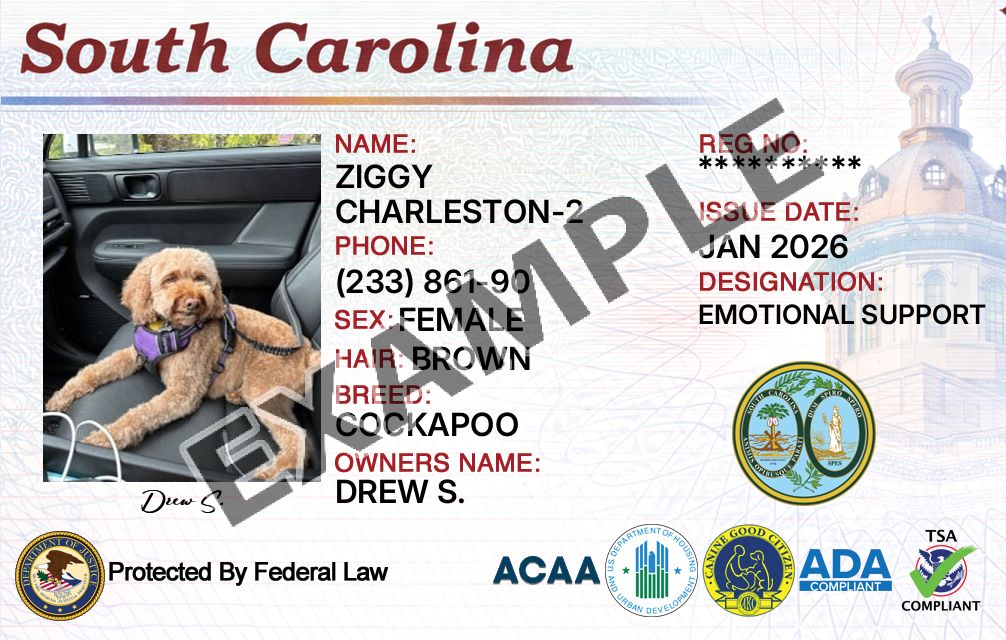
Service Dogs and Emotional Support Animals in Hampton, South Carolina
If you’re asking where do I register my dog in Hampton County, South Carolina for my service dog or emotional support dog, the most important thing to know is this: there is usually no single statewide “service dog registry” or “emotional support dog registry” you must file with. Instead, what most residents actually need is a dog license in Hampton County, South Carolina (when required by a local ordinance) and a current rabies vaccination as required by South Carolina law.
This page explains where to register a dog in Hampton County, South Carolina, what “registration” typically means in practice (local licensing + rabies compliance), and how the rules differ for service dogs versus emotional support animals (ESAs).
Where to Register or License Your Dog in Hampton County, South Carolina
Because dog licensing and enforcement can be handled locally, start with the county animal shelter/animal services contact and then confirm whether your dog’s “license” is handled by the county, your town (if you live inside town limits), or both. The offices below are official government offices and commonly relevant for animal control dog license Hampton County, South Carolina questions, rabies-related issues, and local pet ordinances.
County Animal Shelter / Animal Services Contact
Hampton County Animal Shelter
- Monday, Wednesday, Friday: 10:00 a.m. – 4:00 p.m.
- Tuesday, Thursday: By appointment only
- Saturday: 10:00 a.m. – Noon
- Sunday: Closed
Hampton County (Main Contact)
Local Town Offices (Examples Within Hampton County)
If you live inside town limits, your town may be the place to ask about local animal ordinances, fees, or any town-issued tags. If you live in an unincorporated area, the county is often the best starting point.
| Office | Address | Phone | Hours | |
|---|---|---|---|---|
| Town of Hampton Administrative Office |
608 First St. W Hampton, SC 29924 |
(803) 943-2951 | shaltman@hamptonsc.gov | Mon–Fri, 9:00 a.m. – 5:00 p.m. |
| Town of Varnville |
95 East Palmetto Ave Varnville, SC 29944 |
(803) 943-2979 | Not listed (verify by phone) | Mon–Fri, 8:00 a.m. – 4:30 p.m. |
| Town of Brunson |
686 North Railroad Avenue Brunson, SC 29911 |
803.632.3633 | Not listed as a direct address (site provides “Email” buttons; verify by phone) | Not listed (verify by phone) |
| Town of Yemassee (Administration Department) |
101 Town Cir, Ste. 111 Yemassee, SC 29945-3363 |
(843) 589-2565 Ext. 3 | Not listed (verify by phone) | Not listed (verify by phone) |
Address: 531 W. Carolina Avenue, Varnville, SC 29944
Phone: (843) 953-4713 Fax: (843) 202-7050
Reporting Email: Lowcountry-Rabies@dph.sc.gov
Hours: Monday – Friday, 8:30 A.M. – 5:00 P.M.
Overview of Dog Licensing in Hampton County, South Carolina
What “registering” a dog usually means
When people search for where to register a dog in Hampton County, South Carolina, they often mean one (or more) of these:
- Getting a local dog license (a license/tag issued by a town or county, if required where you live).
- Complying with rabies vaccination requirements and keeping proof (rabies certificate and/or tag provided by your veterinarian).
- Having contact information on file in case your dog is picked up by animal control or involved in a bite report.
Hampton County may handle some animal-related services through county offices (including the county animal shelter), while incorporated towns may have their own ordinances or administrative processes. That is why local offices are the best place to confirm whether you need a specific dog license in Hampton County, South Carolina based on your exact address.
Rabies vaccination is a core requirement (statewide)
Separate from any local licensing rules, South Carolina’s rabies control framework requires pet owners to keep rabies vaccinations current. After vaccination, the veterinarian provides a rabies certificate and typically issues a metal rabies tag associated with that certificate. In addition, county health departments play a role in rabies-related reporting and quarantine orders after bite incidents. Keeping your dog current on rabies is often the “proof” you’ll need to obtain or renew local licensing.
Service dog or ESA status does not replace local licensing
Even if your dog is a trained service animal or an emotional support animal, local rules about vaccination and licensing can still apply. In other words, “service dog” or “ESA” status is not the same thing as being licensed, and it does not automatically mean you’re exempt from local animal control rules.
How Dog Licensing Works Locally in Hampton County, South Carolina
Step 1: Confirm whether your address is in a town or unincorporated Hampton County
The fastest way to avoid confusion is to identify whether you live inside an incorporated municipality (such as Hampton, Varnville, Brunson, or the Hampton County portion of Yemassee) or in an unincorporated area. This matters because local ordinances and processes can differ, and the correct office for an animal control dog license Hampton County, South Carolina question may depend on where you live.
Step 2: Call the county animal shelter or your town office and ask the right questions
When you call, you can keep it simple and ask:
- “Do you issue a dog license or tag for residents at my address?”
- “If licensing is required, what documents do I need to bring (rabies certificate, ID, proof of residency)?”
- “Are service dogs eligible for a reduced fee or waiver, and if so, what do you require?”
- “If you don’t handle licensing, which office does?”
Step 3: Prepare your rabies proof and basic identification
Most local licensing systems (when they exist) are built around rabies compliance. Your veterinarian’s rabies certificate and tag number are frequently used to confirm eligibility for a license or registration record. If your dog is newly acquired, recently moved into the county, or newly vaccinated, ask the office whether there is a deadline to license after moving or after the dog reaches a certain age.
Step 4: Keep records accessible (especially for animal control encounters)
Whether your dog is a pet, service dog, or ESA, it’s wise to keep a copy (paper or digital) of rabies documentation and any local license receipt. If an incident occurs (lost dog, complaint, bite report), having the paperwork helps resolve issues quickly.
Service Dog Laws in Hampton County, South Carolina
Service dog definition (public access) and what you can be asked
Under the ADA framework, a service dog is generally a dog trained to do work or perform tasks for a person with a disability. In public settings where it is not obvious what a dog does, staff may ask only two questions: whether the dog is required because of a disability, and what work or task the dog has been trained to perform. Staff generally may not demand documentation, require the dog to demonstrate tasks, or ask about the nature of the disability.
No mandatory “service dog registration” for public access
There is no ADA requirement that a service dog be certified or registered, and mandatory registration of service animals is not permitted as a condition for entry into public places. That said, service animals can still be subject to local dog licensing and rabies vaccination rules that apply to all dogs.
How this affects “where do I register my dog” searches
If your goal is to have your dog recognized as a service dog for public access, “registration” is usually not the correct step. Instead, focus on:
- Maintaining current rabies vaccination and any locally required licensing, and
- Ensuring the dog is properly trained to perform disability-related tasks and behaves appropriately in public.
Voluntary programs vs. required licensing
Some communities offer voluntary programs (for example, optional identification tags) that may provide benefits like reduced fees. Voluntary programs can exist, but they cannot be required as a condition for public access. If you hear about a program, ask whether it is optional and whether it is run by an official government office (not a third party).
Emotional Support Animal Rules in Hampton County, South Carolina
ESAs are not service dogs (and do not have the same public access rights)
An emotional support animal (ESA) generally provides emotional support that alleviates one or more identified effects of a disability, but ESAs are not the same as ADA-defined service dogs for public access. This means restaurants, stores, and most public places typically do not have to allow an ESA the same way they must allow a service dog.
Where ESAs matter most: housing accommodations
ESAs are most commonly addressed under housing rules. Federal housing guidance describes an “assistance animal” broadly as an animal that works, provides assistance, performs tasks, or provides emotional support that alleviates effects of a disability. In housing, a person with a disability may request a reasonable accommodation to pet restrictions to keep an assistance animal, and a housing provider may request reliable disability-related information when the disability and need are not apparent.
Does an ESA need to be “registered” with the county?
Usually, no special county registration is required just because your dog is an ESA. However, your ESA is still a dog, so local rules may still apply such as:
- Rabies vaccination requirements and proof,
- Any local dog licensing requirements for your address, and
- Leash, nuisance, and vaccination compliance enforced through animal control.
Avoid third-party ESA “certificates” for licensing purposes
If you are trying to solve “registration” for housing, the most useful step is typically to work with your housing provider’s accommodation process and provide appropriate supporting information if requested—not to buy an online registration. For local licensing, the county or town will typically want rabies documentation, not an ESA certificate.
Frequently Asked Questions
Register A Dog In Other South Carolina Counties
Select your county below to get started with your dog’s ID card. Requirements and license designs may vary by county, so choose your location to see the correct options and complete your pup’s registration.
- Abbeville County Dog Registration
- Aiken County Dog Registration
- Allendale County Dog Registration
- Anderson County Dog Registration
- Bamberg County Dog Registration
- Barnwell County Dog Registration
- Beaufort County Dog Registration
- Berkeley County Dog Registration
- Calhoun County Dog Registration
- Charleston County Dog Registration
- Cherokee County Dog Registration
- Chester County Dog Registration
- Chesterfield County Dog Registration
- Clarendon County Dog Registration
- Colleton County Dog Registration
- Darlington County Dog Registration
- Dillon County Dog Registration
- Dorchester County Dog Registration
- Edgefield County Dog Registration
- Fairfield County Dog Registration
- Florence County Dog Registration
- Georgetown County Dog Registration
- Greenville County Dog Registration
- Greenwood County Dog Registration
- Horry County Dog Registration
- Jasper County Dog Registration
- Kershaw County Dog Registration
- Lancaster County Dog Registration
- Laurens County Dog Registration
- Lee County Dog Registration
- Lexington County Dog Registration
- Marion County Dog Registration
- Marlboro County Dog Registration
- McCormick County Dog Registration
- Newberry County Dog Registration
- Oconee County Dog Registration
- Orangeburg County Dog Registration
- Pickens County Dog Registration
- Richland County Dog Registration
- Saluda County Dog Registration
- Spartanburg County Dog Registration
- Sumter County Dog Registration
- Union County Dog Registration
- Williamsburg County Dog Registration
- York County Dog Registration